
How DOAS Systems Improve Indoor Air Quality and HVAC Efficiency

The demand for healthier indoor environments and energy-efficient systems is driving innovation in the HVAC industry. One standout solution is the Dedicated Outdoor Air System (DOAS), a specialized HVAC configuration designed to deliver fresh, conditioned air. But how exactly does DOAS work, and why is it becoming essential in modern building design?
The Case for Dedicated Ventilation
Standard HVAC systems often rely on mixed-air strategies, recirculating indoor air to manage temperature and humidity. While efficient in some contexts, this approach can compromise indoor air quality. This is particularly true in airtight, high-occupancy spaces where contaminants accumulate quickly. DOAS units address this by introducing 100% outdoor air, which is:
- Filtered to remove particulates and pollutants
- Dehumidified to maintain comfort and prevent mold
- Tempered to meet space-specific thermal requirements
This results in:
- Stable ventilation rates regardless of occupancy or load fluctuations
- Lower concentrations of VOCs and pathogens
- Enhanced comfort for occupants
Engineering Around the Efficiency Barrier
Despite their IAQ benefits, DOAS units present a unique set of design and integration challenges that demand thoughtful engineering:
Thermal Load Management
Conditioning outdoor air—especially in regions with high humidity or temperature extremes—can dramatically increase energy demand. Solutions often involve:
- High-efficiency heat exchangers (enthalpy wheels, plate heat recovery)
- Variable-speed EC fans to modulate airflow and reduce power draw
- Smart controls that optimize operation based on occupancy and weather data
Mechanical Footprint Optimization
DOAS units must often be retrofitted into existing buildings or integrated into compact rooftop spaces. This requires:
- Low-profile fan arrays that maintain airflow while minimizing height
- Modular cabinet designs for flexible installation
- Noise-attenuated components to meet acoustic requirements in sensitive environments
This calls for:
- Advanced control logic to manage staging and sequencing
- Communication protocols (BACnet, Modbus) for seamless BMS integration
- Redundancy strategies to ensure uptime in mission-critical applications
Key Takeaways
While DOAS units are excellent for air quality, they face several engineering challenges:
- Energy Consumption: Conditioning outdoor air—especially in extreme climates—requires significant energy.
- Space Constraints: DOAS units must fit into existing rooftop configurations.
- System Integration: They must work seamlessly with parallel HVAC systems like VRF, chilled beams, or fan coils.
This is where advanced airflow technology, like COPRA electronically commutated fans, plays a crucial role.
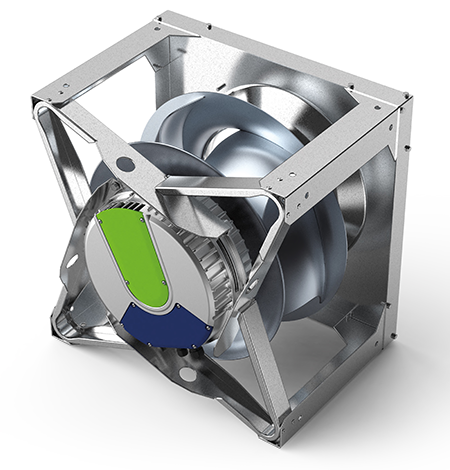
COPRA EC Fans: Elevating DOAS Performance
COPRA EC fans from Nicotra Gebhardt are engineered to meet the unique demands of DOAS systems. Their features directly address the challenges of energy efficiency, space, and integration:
High-Efficiency EC Motors
COPRA fans use electronically commutated motors that deliver up to 10% higher efficiency than traditional plug fans. This is especially valuable in DOAS units, which operate continuously to maintain ventilation standards.
Compact, Space-Saving Design
With a short axial length and integrated motor, COPRA fans fit easily into tight DOAS configurations—whether rooftop-mounted or ceiling-concealed—without compromising airflow performance.
Quiet, Stable Operation
DOAS systems often serve environments like schools, offices, and healthcare facilities. COPRA’s backward-curved aluminum impellers and aerodynamic design reduce noise and vibration, ensuring quiet operation even at high static pressures.
Modular Flexibility
COPRA EC fans support plug-and-play installation and modular fan arrays, making them ideal for scalable DOAS designs. Whether retrofitting an existing system or designing a new one, COPRA fans simplify integration and reduce downtime.
Why COPRA Is the Ideal DOAS Partner

COPRA EC fans combine three qualities once considered incompatible: maximum compactness, outstanding system efficiency, and high-power density. This makes them the perfect match for DOAS systems that demand high performance in a small footprint.
Whether you're designing for a school, hospital, data center, or commercial building, COPRA fans help DOAS systems deliver cleaner air, lower energy bills, and quieter operation.
Connect With Our Experts
Want to learn how COPRA EC fans can optimize your DOAS project? Contact our airflow specialists today to explore tailored solutions for your building’s ventilation needs.

COPRA
High-performance centrifugal fan that provides reliable airflow, robust performance, and proven efficiency for demanding ventilation systems.